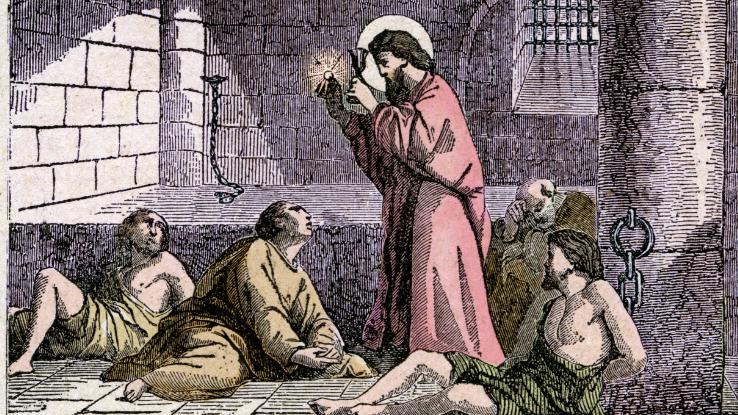
Beloved information technology or hate it, February 14 is historic by millions of people annually. Often referred to as a "Hallmark Vacation," Valentine'due south Day is largely associated with sappy greeting cards, heart-shaped boxes of chocolates, rose-filled bouquets, and other so-chosen symbols of dearest. Of class, it didn't start out this way. So, what are the origins of Valentine's Day — and why has the holiday endured?
The Pagan Origins of Valentine'south Day
Like and so many of our modern-24-hour interval celebrations, Valentine'south Twenty-four hour period may date dorsum to a pagan festival, at least in part. That celebration was known equally Lupercalia, a fertility festival dedicated to Faunus, the Roman god of agriculture, and Rome'south founders, Romulus and Remus. Held on the ides of Feb, Lupercalia was meant to usher in the spring — a fourth dimension that's most often associated with fertility and birth.
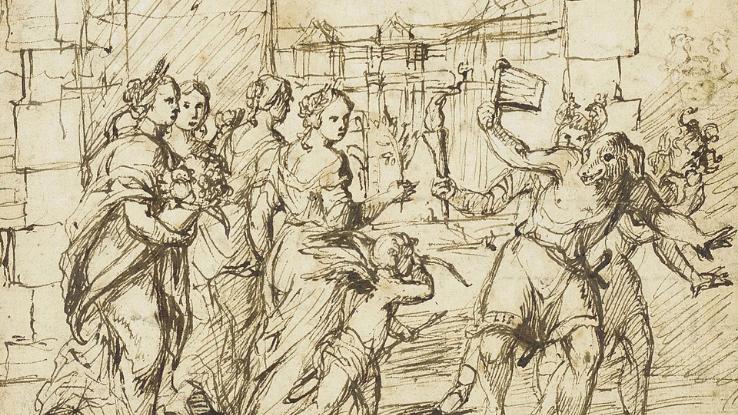
And so, did Lupercalia involve chocolates and heart-shaped sweets? Not exactly. To kick things off, an social club of Roman priests known as the Luperci would get together in a sacred cave where, according to legend, Rome's founders were cared for by a wolf. They would then sacrifice a goat and a dog, animals that correspond fertility and purification respectively. The caprine animal's hide was and so dipped in blood, taken to the fields and, finally, given to the Roman women. According to History, "Roman women welcomed the affect of the hides because it was believed to make them more fertile in the coming yr." All of this ended in a lottery-like matchmaking system to pair the city'southward young women and men together. A niggling more involved than swiping left, huh?
Past the finish of the 400s A.D., Pope Gelasius put an finish to the festival, noting that its pagan roots were in direct opposition to Christianity. In an endeavour to Christianize the holiday, Pope Gelasius decided to supplant Lupercalia with a Christian feast day. During the Middle Ages, folks would associate this feast day with love and romance, particularly in the wake of Geoffrey Chaucer's The Parlement of Foules, a poem near birds finding their mates.
And so, how did this banquet day get known as Valentine's Twenty-four hours? Well, most Christian feast days are associated with a saint and, every bit you lot might be able to guess, Saint Valentine is primarily known every bit the patron saint of lovers. According to the Catholic Church, there were at least iii martyred saints named Valentine or Valentinus, so it's difficult to determine for whom the solar day was named.
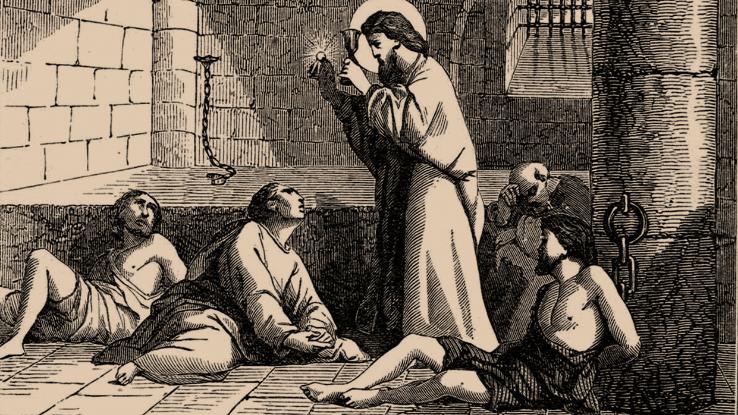
Ane popular legend suggests that when Emperor Claudius 2 of Rome outlawed marriage for the young men in his ground forces, a priest named Valentine performed marriages in hole-and-corner. Somewhen, he was found out and Claudis sentenced him to death. Another Valentine, this ane a bishop, was as well put to death by Claudius the second, though little is known about that potential namesake.
Mayhap the nigh popular fable associated with Valentine'southward Day tells the story of a man who wanted to help Christian people escape Roman prisons. In this telling, the imprisoned Valentine sent the first "valentine" greeting to a young woman who had visited him. It is said that earlier his death, he signed a letter to her "From your Valentine." Of course, which version of Valentine is actually the day'southward namesake doesn't quite thing as much equally what the figure stands for — love, empathy and cede.
How Did Valentine's Day Become the Vacation We Know Today?
Apart from Valentine's alphabetic character of fable, the oldest known valentine came nearly in 1415 when Charles, Duke of Orleans, wrote a honey poem to his wife while he was imprisoned in the Tower of London. Shortly later, King Henry 5 allegedly hired a ghost author to etch a valentine to his dear. But when did the holiday become what we know today?
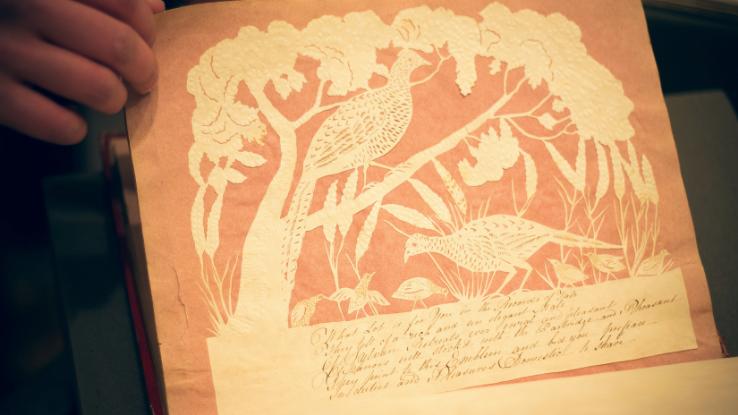
Observed in the United States, Canada, Mexico, France, Australia and the United kingdom, modern Valentine's Solar day as we know information technology was first celebrated in the 17th or 18th centuries, with folks exchanging handwritten notes and small-scale tokens. By the 1800s, Richard Cadbury, the founder of the Cadbury chocolate company, began the exercise of gifting boxes of chocolate on Valentine's Day in the U.G.
Meanwhile, in the U.S., Esther A. Howland, the then-chosen "Mother of the Valentine," start sold mass-produced valentines in the 1840s. And the rest, as they say, is history. These days, the Greeting Card Association estimates that 145 million people send Valentine'south Day cards each yr — and that's not including all those cards kids trade at schoolhouse. Additionally, the National Retail Foundation projected that Americans would spend a staggering $27.four billion in 2020 on Valentine's-related items.
DOWNLOAD HERE
Posted by: estescomeng.blogspot.com


0 Komentar
Post a Comment